Haptic Shoes: Vibrotactile Insoles (2014)
We naturally rely on tactile perception through the feet, for example to perceive qualities of granular surfaces, such as sand or snow. While vibrotactile actuators are common in wearables, there has been little systematic research on leveraging these for information delivery through the foot sole. I developed two generations of instrumented insoles, with the goal to eventually support tactile feedback on balance and locomotion tasks, such as dancing, and human-computer interaction in general. In contrast to previous systems, tactile actuators and sensors are located below the points of highest contact with the ground, heel, big toe, and 1st/5th metatarsal head.

Topics
Methods
- PCB Design + Manufacturing
- Embedded Development (Arduino)
- Mobile Development (Evothings/Cordova)
- Study Design and Execution
- Data Analysis (R)
- Scientific Writing
Initial Prototype
For a first prototype, we placed four eccentric rotating mass actuators inside a foam insole, at the above locations; a simple approach similar to the actuator integrations demonstrated in previous literature.


I conducted a pilot study to quantify user’s ability of users to discriminate between 14 tactons, spatio-temporal activation sequences, of three tactors while standing. We found finding near-perfect recoginition rates when coupling between actuators and foot-sole was good, but when the sole was only lightly loaded, each actuator made the entire insole vibrate, hindering discrimination.
Developing a suitable actuator integration
The next step was to improve actuator integration to ensure good foot-actuator coupling and inter-actuator decoupling. We evaluated a number of materials and integrations in a single-actuator testbed.


Second Prototype: Instrumented, Improved Integration
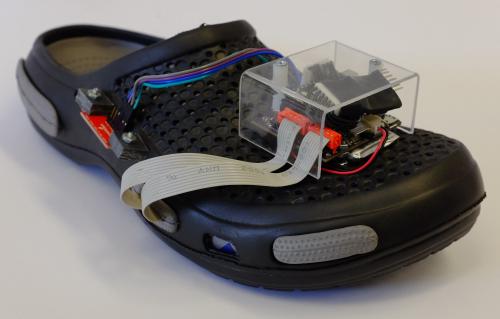
The result was a robust insert based on the concept of a baffle, simliar to a loudspeaker. We also designed a custom PCB for more robust and capable on-shoe electronics, and added sensors: force-sensing resistors under the actuators to measure their loading, and a time-of-flight proximity sensor to measure step height.


I developed a mobile phone web app, connected to the shoe through Bluetooth Low Energy, controlling tacton delivery, collecting participants responses (see next section), and as general interface to the shoe hardware.


Study: Tacton Recognition Rates
We evaluated this integration with another tacton discrimination study, this time including a walking condition. Tactons where delivered just before footfall, when plantar tactile sensitivity is believed to be highest. We asked participants to distinguish between six tactons and found that detection was nearly perfect during stance and still remained high (~75%) during gait.


Study: Angular Menu Feedback
Foot-based interface control may present an appealing option when the hands are occupied, such as in the control of machines (car pedals) and instrumentation for doctors. Radial menus can be controlled by ankle rotation, but auditory feedback to allow more than a few items might not be suitable, for example due to ambient noise. We compared two types of vibrotactile pulses against an auditory click for indicating steps in an angular menu of 3, 6, or 9 items (shown below) and found that while not as good as auditory, vibrotactile feedback allowed still enabled good user performance. We found that a directional feedback was significantly better than simultaneous activation of the L/R tactor, possibly due to the light loading of the foot during sitting.


Publications
- Anlauff, J., Fung, J., & Cooperstock, J. R. (2017, June). VibeWalk: Foot-based tactons during walking and quiet stance. In 2017 IEEE World Haptics Conference (WHC) (pp. 647-652). IEEE.
- Anlauff, J., Kim, T., & Cooperstock, J. R. (2018, March). Feel-a-bump: Haptic feedback for foot-based angular menu selection. In 2018 IEEE Haptics Symposium (HAPTICS) (pp. 175-179). IEEE.