Spatial: Spatial Data Projects (2025)
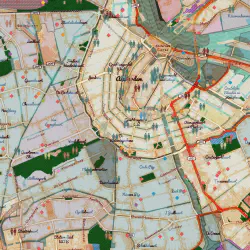
I extended my exisiting data science/engineering knowlege to spatial information and its analysis and presentation. here are some snapshot of my journey and ongoing projects:
Berlin Bike Risk
Do bike infrastructure projects reduce accidents with injury? For this, contrast history data on accidents between bikes and motorized vehicles; 2018/19 vs 2020/21/22. We chose to consider Berlin, and a neighbourhood close to the wall with a lot of demographic change and thus potential infrastructure debt in the last decades, Neukoelln.
BRIX5: Modular Vibrotactile Wearable Toolkit (2020)
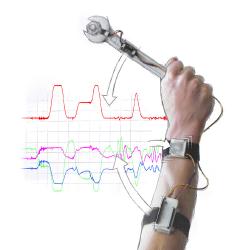
Few open and reproducible tools exist for prototyping wearable sensor-actor systems with state-of-the art vibrotactile haptics, e.g., for augmented feedback applications or novel human-computer interfaces. As part of my thesis work and project NeuroCommTrainer, I developed BRIX5, a modular platform for prototyping feature-rich wearables. Based on the interconnect specifications Qwiic and Feather, BRIX5 is compatible with a rapidly growing open ecosystem. Key contribution are an adaptable base module and compact extensions for motion sensors, arrays of both narrow-, and wide-band voice coil tactile actuators. Filling the gap between proprietary, off-the-shelf wearables and custom prototypes, we plan to release BRIX5 as open hardware, as a step towards a common platform for shared vibrotactile wearable research and teaching. BRIX5 provided the basis for the recent belt and NeuroCommTrainer prototypes, and was developed in collaboration with Sebastian Zehe (hardware design and assembly) at the AmI Lab.
NeuroCommTrainer: Vibrotactile Brain-Computer-Interface (2020)
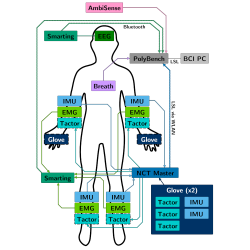
Every year, several thousand severe traumatic brain injury cases occur, e.g., through accidents or stroke, often resulting in permanent partial loss of consciousness and communication ability. Misdiagnosis rates of DoC patients are high (~40%), and there are limited means for therapy so far. NeuroCommTrainer is a multi-modal brain-computer interface for such minimally responsive individuals, using the senses of touch and hearing together with event-related neural responses or residual motor-function to re-establish basic communication, e.g, to allow yes/no answers, or operation of a speller for text input.
TactBlaster 24k: Multichannel HD Haptics Vibrotactile Driver (2020)
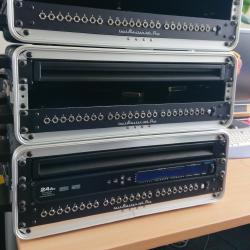
TactBlaster 24k is a low-latency, many-channel HD-haptics driver system for vibrotactile research. We built it to drive up to 72 channels of voice-coil tactors, with three portable units for 24 channels each. These consist of three Syntacts boards and one MOTU 24AO external soundcard.
Balance Belt: Vibrotactile Balance Feedback (2020)
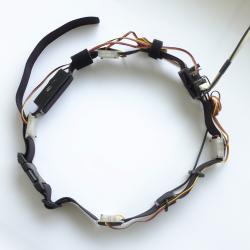
In my Ph.D. thesis at the Shared Reality Lab of McGill University, I investigated vibrotactile feedback systems for balance feedback, specifically a belt for novel feedback mappings, and shoes (described on their own page). The belt combines four state-of-the-art voicecoil actuators and an orientation sensor, forming a test-bed for embedded or external synthesis of novel trunk-tilt feedback.
Aurora: Heliostat Array Kinetic Sculpture (2019)
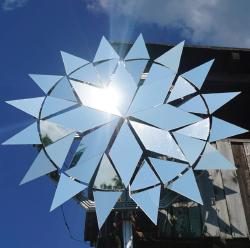
Aurora is a kinetic sculpture, an array of 40 mirrors each able to tilt in two axes, to track the sun movement as a heliostat and to enable artistic lighting with the sun, a project initiated and led by the artist blausand. My role was initial prototype design, project coordination during the fast-paced project sprints, electronic implementation and all aspects software besides the animations. Many others helped in the projects development, the website is http://aurora.blausand.net.
Haptic Shoes: Vibrotactile Insoles (2014)
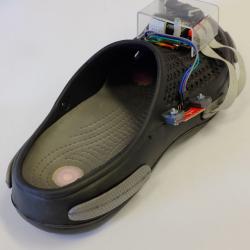
We naturally rely on tactile perception through the feet, for example to perceive qualities of granular surfaces, such as sand or snow. While vibrotactile actuators are common in wearables, there has been little systematic research on leveraging these for information delivery through the foot sole. I developed two generations of instrumented insoles, with the goal to eventually support tactile feedback on balance and locomotion tasks, such as dancing, and human-computer interaction in general. In contrast to previous systems, tactile actuators and sensors are located below the points of highest contact with the ground, heel, big toe, and 1st/5th metatarsal head.
Solderin' Skaters: Tilt'n'Roll - Augmented Skateboarding Game (2011)
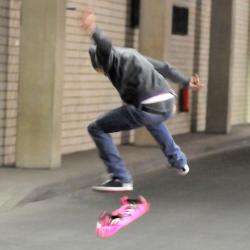
The Nokia PUSH design challenge asked for teams to “hack” novel and creative applications with their new N900 Linux smartphone - within roughly two months. I was part of the team “Solderin’ Skaters”, and our entry was an augmented skateboarding game, controlled by performing real tricks on a skateboard equipped with motion sensors.
tacTiles: Low-Cost, Room-Scale Tactile Sensing (2010)
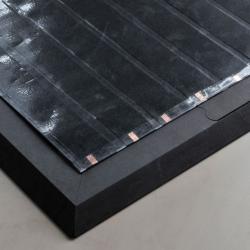
As my Master’s thesis (in computer science, Ambient Intelligence Group, Bielefeld University), I developed a modular, low-cost tactile sensing system to detect user’s presence and activity in a smart environment through pressure-sensing floor tiles.
With a spatial resolution of 5 cm, it could detect steps and their ground-force characteristics. The goals was to substitute or complement visual tracking, often problematic due to visual occlusions and privacy implications. The system outputs its reading through a USB-Video-Stream (UVC) like a webcam, allowing analysis with a computer vision toolchain.
The sensor grid is based on conductive paper, laser-cut to form a force sensing resistor (FSR) matrix (illustrated below), making it very cheap to reproduce materials-wise. An array of modules, based on a custom AVR 8-Bit microcontroller board, are read out by an AVR32 master controller, based on myrmex). The modules can be arranged flexibly around areas of interest.


