Solderin' Skaters: Tilt'n'Roll - Augmented Skateboarding Game (2011)
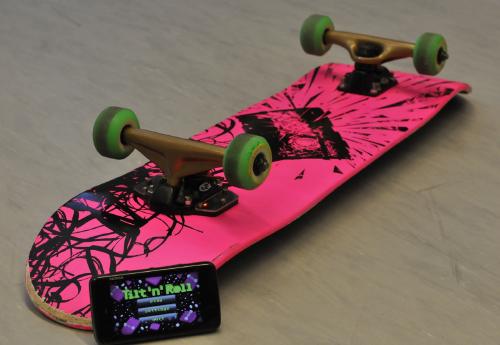
The Nokia PUSH design challenge asked for teams to “hack” novel and creative applications with their new N900 Linux smartphone - within roughly two months. I was part of the team “Solderin’ Skaters”, and our entry was an augmented skateboarding game, controlled by performing real tricks on a skateboard equipped with motion sensors.

Topics
Methods
- PCB design, assembly (reflow), testing
- Embedded programming (AVR-C)
- Principal Photography
Our project challenged skaters to come back on the streets, prompted by the video game skateboard controllers (Tony Hawk’s Ride) introduced at the time. I was responsible for the custom electronics (wireless sensor assembly) and the embedded programming of the highly integrated circuit board called we called Diptera, for its intended purpose of flying with the skater. With a team of 9 in total, we manages to go from idea to functional prototype in just under two months, exceeding expectations and demonstrating what open soft and hardware could enable, back in 2010.
Diptera Development
Diptera boards captured the high acceleration, angular velocity of the board, and pressure distribution during tricks and relaying it to the N900 phone via Bluetooth. Diptera combined an ATMega328 microcontroller, a Bluegiga Bluetooth module, an ADXL345 accelerometer, 2 dual-axis high-rate gyrometers, and analog sampling of two FSR strips under the grip tape. We mounted one Diptera module under each truck, in a CNC-milled foam insert absorbing the worst impacts.


Operating Principle
On the phone, a machine learning classified tricks, subsequently awarding users points, providing encouraging remarks and an increasingly up-beat soundtrack. Intended to eventually become an early example of a location-based game, our softare allowed skaters to tweet highscores with location.


Unit Testing
Our team’s test skater putting the system to the test:


Later uses
We later reimplemented the machine learning for the subsequent Nokia N9 campaign by Wieden and Kennedy, reaching impressive recognition rates and becoming part of a global campaign to advertise Linux phones by Nokia - unfortunately, not becoming a widespread reality.
Before long, the extra boards we had made were used by collegues at the Ambient Intelligence Group at Bielefeld University for Human-Computer Interaction research, as compact and extensible wireless sensor boards were hard to get back then. Diptera can be considered the inspiration for the BRIX, BRIX2, and BRIX5 wearable prototyping toolkits.
Publications
- Demo Video (Youtube)
- Anlauff, J., Weitnauer, E., Lehnhardt, A., Schirmer, S., Zehe, S., & Tonekaboni, K. (2010, November). A method for outdoor skateboarding video games. In Proceedings of the 7th International Conference on Advances in Computer Entertainment Technology (ACE'10) (pp. 40-44). (Paper)
- We exhibited the project as part of the V&A DECODE showcase at the Victoria & Albert museum in London (2011)